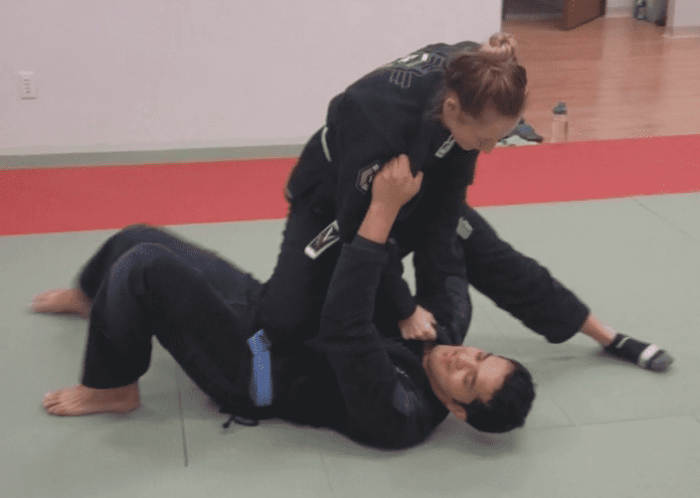
Step into the thrilling world of martial arts where discipline meets skill and tradition merges with modern techniques. Get ready to explore the fascinating realm of popular martial arts styles that have captivated enthusiasts worldwide.
From the ancient origins to the cultural significance, this topic delves deep into the diverse techniques and philosophies that define each martial arts style, offering a comprehensive view of this dynamic discipline.
MARTIAL ARTS
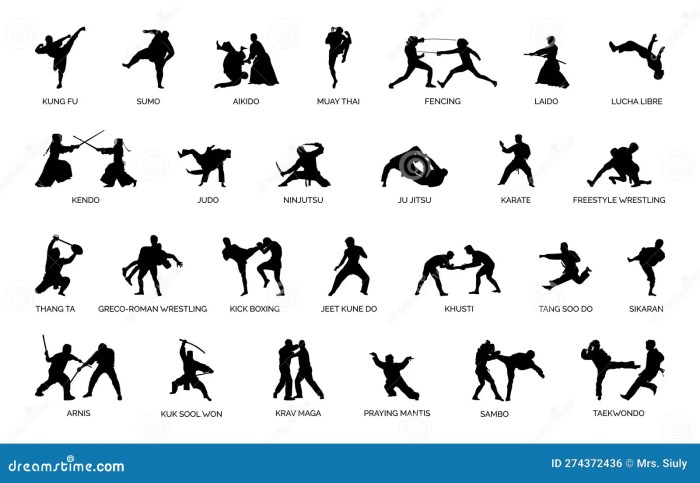
Martial arts have a rich history dating back centuries, with origins in various cultures around the world. These combat practices were developed for self-defense, military training, mental discipline, and physical fitness.
Types of Martial Arts
There are numerous types of martial arts, each with its unique techniques, traditions, and philosophies. Some popular styles include:
- Karate: Originating from Okinawa, Japan, Karate focuses on striking techniques like punches, kicks, and knee strikes.
- Taekwondo: A Korean martial art known for its dynamic kicking techniques and emphasis on self-discipline and respect.
- Judo: Developed in Japan, Judo is a grappling-based martial art that focuses on throws and ground fighting.
- Kung Fu: A Chinese martial art that includes a wide range of styles focusing on striking, kicking, and animal mimicry techniques.
Importance and Benefits of Practicing Martial Arts
Practicing martial arts offers a range of physical, mental, and emotional benefits for individuals of all ages. Some key advantages include:
- Improved physical fitness and coordination
- Enhanced self-confidence and self-discipline
- Stress relief and mental clarity
- Development of important life skills such as focus, perseverance, and respect
POPULAR MARTIAL ARTS STYLES
Martial arts have a rich history and a wide variety of styles that have gained popularity worldwide. Each popular martial arts style has its own unique characteristics, techniques, and cultural significance. Let’s explore some of the most well-known martial arts styles in the world.
Karate
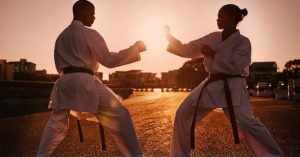
Karate is a Japanese martial art that focuses on striking techniques such as punches, kicks, knee strikes, and elbow strikes. It emphasizes fast and powerful movements, as well as disciplined training. Karate practitioners often wear a white uniform called a gi and earn different colored belts to signify their rank and skill level.
Taekwondo
Originating from Korea, Taekwondo is known for its dynamic kicking techniques and emphasis on speed and agility. Practitioners of Taekwondo also wear a dobok (uniform) and progress through colored belt ranks. It is a popular martial art for self-defense and as a competitive sport in events like the Olympics.
Judo
Judo, developed in Japan, is a grappling-based martial art that focuses on throws and joint locks. It emphasizes using an opponent’s strength and momentum against them. Judo practitioners wear a white or blue uniform called a judogi and aim to immobilize or subdue their opponent through skillful techniques.
Kung Fu
Kung Fu is a Chinese martial art that encompasses a wide range of fighting styles and techniques. It includes both striking and grappling techniques, as well as weapons training. Kung Fu practitioners often train in forms (katas) that combine fluid movements with strength and precision.
Brazilian Jiu-Jitsu
Brazilian Jiu-Jitsu (BJJ) is a martial art that focuses on ground fighting and submission techniques. It emphasizes leverage and technique over brute strength, making it suitable for practitioners of all body types. BJJ practitioners wear a gi during training and competitions, aiming to control and submit their opponent through joint locks and chokes.
Muay Thai
Muay Thai, also known as Thai boxing, is a striking art from Thailand that incorporates punches, kicks, elbows, and knee strikes. It is known for its high-impact and powerful techniques, as well as its conditioning and clinch work. Muay Thai fighters often compete in ring fights using a combination of striking and clinching techniques.
KARATE
Karate is a traditional Japanese martial art that has gained popularity worldwide for its focus on striking techniques using kicks, punches, knee strikes, and elbow strikes. It emphasizes self-discipline, physical conditioning, and mental focus.The origins of Karate can be traced back to the island of Okinawa, where it developed as a form of self-defense against armed invaders. Over time, it evolved into a system of fighting techniques that were influenced by Chinese martial arts and indigenous Okinawan fighting styles.
Key Principles and Philosophy behind Karate
- Karate emphasizes the importance of discipline, respect, and humility in its practice.
- Central to Karate philosophy is the concept of “karate-do,” which translates to “the way of the empty hand.” This signifies the idea of using one’s body as a weapon, without the need for any external tools.
- Practitioners of Karate strive to develop not only physical strength but also mental fortitude, focusing on self-improvement and personal growth.
Different Karate Forms and Their Differences
| Form | Description |
|---|---|
| Shotokan | Known for its powerful, linear techniques and strong stances. |
| Wado-Ryu | Emphasizes fluid movements and redirects the opponent’s energy. |
| Goju-Ryu | Focuses on close-range combat and breathing techniques for power. |
| Shito-Ryu | Incorporates a combination of hard and soft techniques, emphasizing kata (forms). |
TAEKWONDO
Taekwondo is a Korean martial art known for its emphasis on dynamic kicking techniques, which sets it apart from other styles. It combines self-defense, combat techniques, sport, exercise, and philosophy. Let’s delve into the history and evolution of Taekwondo, its focus on kicks and strikes, as well as the significance of the belt ranking system.
History and Evolution of Taekwondo
Taekwondo originated in Korea and has a history dating back to over 2,000 years. It was influenced by ancient Korean martial arts, as well as Chinese and Japanese martial arts. The modern form of Taekwondo was established in the 1950s and 1960s, with various schools and organizations promoting its practice worldwide. The World Taekwondo Federation (WTF) and the International Taekwon-Do Federation (ITF) are two of the largest governing bodies for Taekwondo.
Emphasis on Kicks and Strikes in Taekwondo
Taekwondo places a strong emphasis on kicks, with practitioners using their legs to execute powerful strikes. Kicking techniques are often fast, dynamic, and precise, making Taekwondo an exciting and visually impressive martial art to watch. Strikes with the hands and arms are also important in Taekwondo, though they are typically used in combination with kicks to create effective offensive and defensive strategies.
Belt Ranking System and Its Significance in Taekwondo
In Taekwondo, practitioners progress through a belt ranking system that signifies their level of skill and experience. The colors of the belts typically range from white for beginners to black for advanced practitioners, with different colored belts representing different stages of development. Advancing to a higher belt level requires the demonstration of proficiency in forms (patterns), sparring, self-defense techniques, and other aspects of Taekwondo training.
The belt ranking system serves as a motivational tool for students and helps them set goals for their training and progression in the martial art.
JIU-JITSU
Brazilian Jiu-Jitsu, often referred to as BJJ, is a martial art that focuses on ground fighting and submission techniques. It originated from Kodokan Judo in Japan and was brought to Brazil by the Gracie family in the early 20th century. Over time, Brazilian Jiu-Jitsu evolved into its own unique style, emphasizing leverage, technique, and control to overcome larger opponents.
Origins and roots of Brazilian Jiu-Jitsu
Brazilian Jiu-Jitsu traces its roots back to Mitsuyo Maeda, a Japanese judoka who traveled to Brazil in the early 1900s. Maeda taught Carlos Gracie, who then passed on his knowledge to his brothers, most notably Helio Gracie. The Gracie family further developed the art, refining techniques that would allow a smaller, weaker individual to defend themselves against a larger, stronger opponent.
Techniques used in Jiu-Jitsu for ground fighting
In Brazilian Jiu-Jitsu, practitioners focus on grappling and ground fighting, aiming to control their opponent through joint locks and chokeholds. Common techniques include guard passes, sweeps, submissions, and positional control. By utilizing leverage and proper technique, BJJ practitioners can neutralize their opponent’s strength and size advantage, ultimately leading to a submission victory.
Role of Jiu-Jitsu in modern MMA competitions
Brazilian Jiu-Jitsu has played a significant role in the evolution of modern mixed martial arts (MMA) competitions. Fighters who have a background in BJJ often excel in MMA due to their ability to control the fight on the ground and submit their opponents. Many MMA champions, such as Royce Gracie, Anderson Silva, and Demian Maia, have showcased the effectiveness of Brazilian Jiu-Jitsu in the octagon, solidifying its place as a fundamental skill set in MMA.
KUNG FU
Kung Fu, also known as Chinese martial arts, is a traditional fighting style that originated in China. It is characterized by a combination of physical exercises, self-defense techniques, and philosophical principles.Kung Fu encompasses a wide range of styles, each with its own unique characteristics and techniques. Some popular styles include Wing Chun, Shaolin Kung Fu, Tai Chi, and Wushu. Wing Chun focuses on close-range combat and quick strikes, while Shaolin Kung Fu emphasizes strength and flexibility.
Tai Chi is known for its slow, flowing movements and emphasis on internal energy, while Wushu is a more modern and performance-oriented style.The influence of Kung Fu in popular culture and movies cannot be understated. Films like “Enter the Dragon” starring Bruce Lee and “Crouching Tiger, Hidden Dragon” have helped popularize Kung Fu around the world. The graceful and powerful movements of Kung Fu practitioners have captured the imagination of audiences everywhere, making it one of the most recognized martial arts styles globally.
Different Styles of Kung Fu
- Wing Chun: Focuses on close-range combat and quick strikes.
- Shaolin Kung Fu: Emphasizes strength, flexibility, and traditional forms.
- Tai Chi: Known for slow, flowing movements and internal energy cultivation.
- Wushu: A modern and performance-oriented style with acrobatic movements.
MUAY THAI
Muay Thai, also known as Thai boxing, is a martial art that originated in Thailand and has a rich history deeply intertwined with the country’s culture. Dating back centuries, Muay Thai was originally developed as a form of close combat that utilized the entire body as a weapon in battle.
History and Cultural Significance
Muay Thai has played a significant role in Thai culture, with the practice of the art being deeply rooted in tradition and spirituality. Historically, Muay Thai was used by Thai soldiers in warfare, and over time, it evolved into a popular sport that is now practiced worldwide. The art form is not only a means of self-defense but also a way to honor Thailand’s heritage and traditions.
Techniques in Muay Thai
Muay Thai is known for its powerful striking techniques, which include punches, kicks, elbows, and knees. One of the distinguishing features of Muay Thai is the clinch, a close-quarter grappling technique used to control an opponent’s movements and set up strikes. Elbows and knees are also crucial in Muay Thai, as they can deliver devastating blows to opponents.
Training Methods and Conditioning
Training in Muay Thai involves a combination of rigorous physical conditioning and technical skill development. Fighters focus on building strength, endurance, and agility to withstand the demands of the sport. Training often includes shadow boxing, pad work, sparring, and heavy bag work to improve technique and timing. Additionally, Muay Thai fighters often engage in specific conditioning drills to toughen their shins, elbows, and knees for striking.
MMA (MIXED MARTIAL ARTS)
Mixed Martial Arts, commonly known as MMA, has evolved into one of the most popular combat sports in the world. It combines techniques from various disciplines to create a dynamic and versatile form of fighting that tests the skills of athletes in a wide range of combat scenarios.
Evolution of MMA as a combat sport
MMA originated as a way to determine the most effective martial art in a real-life combat situation. It gained mainstream popularity in the early 1990s with the inception of the Ultimate Fighting Championship (UFC), which brought together fighters from different disciplines to compete against each other. Over the years, MMA has evolved into a well-established sport with a dedicated fan base and professional athletes competing at the highest level.
Different disciplines integrated into MMA
In MMA, fighters incorporate techniques from disciplines such as Brazilian Jiu-Jitsu, Muay Thai, wrestling, boxing, and judo. This integration of striking, grappling, and ground fighting allows fighters to adapt to different situations in the cage and employ a diverse set of skills to gain an advantage over their opponents.
Notable MMA fighters and their impact on the sport
Notable MMA fighters like Conor McGregor, Georges St-Pierre, Anderson Silva, and Ronda Rousey have made significant contributions to the sport and helped elevate its popularity. These fighters have showcased exceptional skills, charisma, and determination inside the cage, inspiring a new generation of athletes to pursue a career in MMA. Their impact on the sport has been profound, shaping the way MMA is viewed and appreciated by fans around the world.
Last Word
As we conclude our journey through the realm of popular martial arts styles, it’s evident that these combat forms are not just physical practices but rich traditions steeped in history and philosophy. Embrace the wisdom of the masters and continue to explore the depths of combat mastery in the world of martial arts.
FAQ Guide
What are the key characteristics of popular martial arts styles?
Popular martial arts styles are known for their unique techniques, forms, and philosophies that set them apart from each other, catering to different preferences and combat strategies.
How do different popular martial arts styles compare in terms of techniques?
Each popular martial arts style emphasizes specific techniques such as striking, grappling, or ground fighting, showcasing the diverse range of combat approaches within the martial arts spectrum.
What is the cultural significance behind each popular martial arts style?
Popular martial arts styles are deeply rooted in the cultures from which they originated, reflecting traditions, values, and beliefs that have been passed down through generations, shaping the essence of each combat form.